



The Monolith appliance standing on a desk beside a monitor showing its security dashboard, in a high-rise office
Monolith

Trust is earned continuously.So Monolith proves it continuously.

An autonomous security agent at the chokepoint of your intranet. It detects, it fixes, and it isolates at the network layer — and gives the CISO one command view of the whole estate. Deploy it on-premises or in your own cloud, with the Monolith Model or the model you already run.

Engineered by Guardian Robotics with Blackfrost AI

Continuous
Controls exercised around the clock — not once a quarter, not once a year
Local or cloud
On-premises appliance or your own cloud tenancy. Your model or ours. Either way, the boundary is yours
Minutes, not quarters
Exposure window compressed from discovery to verified remediation
Full evidence chain
Every action attributable, hash-chained, and outside the agent’s reach
Close detail of the Monolith chassis: machined cooling fins along a brushed metal spine
Machined chassis, passive fin stack
The Monolith appliance beside a glass-walled conference room
One operator per site
The Monolith appliance installed on the floor of an office
In-line, between the edge and everything behind it
The thesis

The gap between knowing and being protected
is measured in weeks. Exploitation is measured in hours.

A bulletin lands, a CVE drops, a new technique is published — and nothing changes on the estate until a detection engineer gets to it, a ticket clears a change board and a window opens. Meanwhile the attack surface now includes AI agents nobody has written an access policy for. Most security programmes are built on assumptions that were true at the last assessment. The firewall rule that was correct in March. The EDR agent that silently stopped reporting in June. The egress policy nobody has validated since the last migration. Control coverage gets measured constantly; control efficacy gets measured annually, by a consultant, against a scope agreed six weeks earlier.

Meanwhile exploitation of a new CVE is routinely measured in hours. The gap between how fast your attack surface changes and how fast you can prove your controls still hold is where breaches live. Monolith is built to close that gap — and to give you the evidence, continuously, rather than the assurance.


The operating loop

Detect. Propose. Approve.
Remediate. Verify.

Monolith is not another console that generates work for your team. It runs the loop itself, end to end, and brings you one decision at a time with the remediation already staged.

  1. 1

    Monolith runs. Constantly.

    In-line on the intranet, it maintains a live model of the estate — every asset, every flow, every exposed service — and re-baselines continuously as the environment changes. New vulnerabilities, configuration drift and fresh exposures are picked up as they happen, not at the next scan window.

  2. 2

    It proposes the fix. You approve. It remediates.

    Each finding arrives with severity, blast radius and the remediation already staged — block this egress, close this port, isolate this host, apply this policy. One approval and Monolith executes it, verifies the change took, and writes the full action record to an evidence store it cannot edit. Pre-approved classes of fix run without waiting.

  3. 3

    It tells you the moment something tries.

    Attempted compromise of the network or an endpoint is contained first and reported immediately: what was blocked, the source, the technique, and whether anything remains unresolved. You are notified of the outcome — not handed a queue of alerts to investigate.

What it is

Your intranet has one chokepoint.
Monolith manages it.

Everything on the intranet passes a bottleneck: the point between the edge and the estate behind it. Monolith sits on that point. From there it does three things, and it does them itself rather than filing a ticket for someone else to do.

01

Detect

Identity, endpoint and network evidence correlated at the chokepoint into true-positive attack paths in seconds. Controls exercised continuously, intelligence run against your digital twin, silence treated as the finding.

  • True-positive verdicts, not alert volume
  • Human and machine identity, baselined per agent
  • Administrative layer: domains, DNS, certificates, registrars
02

Fix

The remediation is staged before you see it: the detection written, the control change prepared, the patch sequenced. You approve, or you have pre-approved the class, and Monolith applies it and verifies it closed.

  • Detection logic written, deployed, re-tested
  • Configuration and control drift corrected
  • Exposure window measured before and after
03

Isolate

Isolation happens at the network layer, because Monolith is in-line. A host, an identity, an agent or a whole segment is cut off at the wire in seconds — no endpoint software to trust, no agent that can be killed first, no exception for the device that was never enrolled.

  • Host, identity, agent or segment — isolated at the wire
  • Egress blocked, credentials revoked, session frozen
  • Reversible in one action, evidenced end to end
  • How this stops social engineering →
Command view

The whole estate on one screen.
Built for the CISO and the CTO, not the queue.

One live view of posture, exposure, every agent on the network and every action Monolith has taken or is waiting to take. Not a dashboard that summarises other tools — the operator’s own view of the chokepoint it manages. Drill from a board-level number to the packet, the identity and the evidence record behind it.

  • Posture at a glance. Controls exercised, controls that failed, exposure window by class, trend over time.
  • Every agent, every identity. Human and machine, with stated authority and current behaviour against it.
  • Approvals and autonomy. What is waiting for a decision, what ran under pre-approval, what was isolated and why.
  • Evidence on demand. The record you hand the auditor or the board, with nothing editable after the fact.

Running it

Easy to run. Set it and forget it.
And when something happens, it moves first.

Monolith is a security operator, not another console. It is in-line on day one, needs nothing rolled out to endpoints, and runs the loop by itself. You hear from it when it has done something or needs one decision — in plain language, with every action it took and the proof that the same thing cannot happen again.

EASY TO USE

In-line on day one.

One appliance between the edge and the estate. No agents to roll out, no rules to write, no console to learn. It discovers the estate, baselines it, and starts exercising controls the same day.

SET IT AND FORGET IT

It runs. You decide.

Pre-approve the classes of fix you are comfortable with and Monolith handles them. Everything else arrives as one decision with the remediation already staged. No queue to work, no dashboard to babysit.

DURING AN INCIDENT

Seconds, not shifts.

Isolation at the wire in seconds. Credentials revoked, egress blocked, remediation applied and verified — while the incident is still an incident, not a report.

NEVER AGAIN

Closed, then proven closed.

After every incident the chain is replayed against your digital twin, the detection is written and verified, and the control change is applied. The same path cannot be walked twice, and the record shows why.

Clear communication

It tells you exactly what it did.
In plain language, every time.

No alert soup. Every message from Monolith has the same four parts, written for the person who has to decide, not for the analyst who has to decode it.

  • What happened. One paragraph, no jargon, with the severity and the evidence behind it.
  • What Monolith did. Every action it took, timestamped, in order.
  • What it needs from you. Usually nothing. Sometimes one approval, with the fix already staged.
  • So it cannot happen again. The detection written, verified on the twin, and the control it changed.

What happens in week one

A real gap in your environment,
with the fix already staged.

We do not open with a deck. In the first week Monolith runs the digital twin against a representative slice of your estate and executes attack profiles from last month’s sector bulletins. We show you the one your controls did not catch — and the detection already written for it.

  1. Week 1First findingTwin stood up against a slice of the estate; a real detection gap, evidenced, with the fix staged.
  2. Day 30Measurable valuePre-approved remediation classes live. Exposure window tracked before and after — one number, going down.
  3. Quarter 1Governing the estateOperating loop running end to end, to a published standard, with an evidence chain nobody on your team can edit.

Attack paths, not alerts

True-positive attack chains,
analysed in seconds.

A SOC drowns in isolated alerts because each one is scored on its own. Monolith reasons across them. A DNS anomaly on one host, a new scheduled task on another, an outbound connection to infrastructure first seen yesterday — individually noise, together a kill chain. It assembles the path, scores it as a whole, and hands you a true positive with the containment already staged.

  • Correlated across identity, endpoint and network — the chain is built from the evidence an attacker cannot avoid leaving.
  • Scored end to end, not event by event — so low-severity signals that only matter together are not discarded.
  • Seconds from first signal to a reconstructed path — local inference, no queue, no analyst backlog in front of it.
  • Every link in the chain is evidence — the full reconstruction is written to the tamper-evident record.
Attack path · reconstructed in 4.1s
  1. T+0:00
    Initial accessPhishing attachment opened · WS-114
  2. T+0:02
    PersistenceScheduled task created · WS-114
  3. T+0:09
    DiscoveryLDAP enumeration · 1,240 objects
  4. T+0:11
    Lateral movementSMB to FS-02 with harvested credential
  5. T+0:14
    Exfiltration attemptEgress to 203.0.113.45 · blocked
VerdictTrue positive · CriticalContainment staged: isolate WS-114, revoke session, block egress

Intelligence to protection

Every TTP and IOC published anywhere,
turned into a detection on your estate.

ISACs, vendor advisories and threat feeds publish intelligence that is generic by design: this actor is targeting your sector with this technique. Somebody still has to turn that into an alert that fires on your infrastructure — and that is weeks of detection engineering most teams never get to. Monolith closes the loop automatically.

  1. 01

    Ingest all of it

    TTPs, IOCs, ISAC bulletins, CVE disclosures, vendor advisories, open and commercial feeds. The AI reads every piece of intelligence available and pulls it into your environment continuously.

  2. 02

    Decompose into attack profiles

    Each threat is broken down into the concrete sequence an adversary would execute against an estate like yours — initial access, persistence, movement, objective — not a headline.

  3. 03

    Run it against your digital twin

    The profile is executed against a masked replica of your real topology: same assets, same controls, same configuration, none of your production data. It is a safe, exact rehearsal of the attack on you specifically.

  4. 04

    No alert in the sim? That is the gap.

    If the twin raises nothing, your real estate would have raised nothing. Monolith treats silence as the finding: a blind spot, located and evidenced before an attacker uses it.

  5. 05

    Build the detection. Configure it. Protected.

    It writes the detection logic and the control change for that specific gap, uploads and configures it, then re-runs the profile against the twin to confirm the alert now fires. You are notified of the outcome, not asked to do the work.

The AI-native capability

This is not a SIEM with a model bolted on. Correlation across every feed, every technique and the specific shape of your infrastructure — at the rate intelligence is published — is beyond any human team. It is exactly what an AI-native agent that reads everything, simulates everything, and acts on its own findings can do before the next bulletin lands. Enablement and speed, not another console.

  • AI-native, not AI-assisted
  • Minutes from bulletin to deployed detection
  • Generic intel made specific to you
  • Every gap evidenced before it is exploited

Identity: human and machine

The new insider is not a person.
It is an agent with your credentials.

Every AI agent you deploy is an insider with standing access, machine speed, and no instinct for what it should not touch. Corporate policy written for people has no vocabulary for an actor that acts on behalf of someone, under delegated authority, for a bounded purpose — and might spawn more of itself. This is the hardest problem in the AI environment, and it is Guardian’s core discipline.

HUMAN IDENTITY

Who is actually on the other side of the screen?

In a remote-only organisation nobody has physically met the worker on the VPN. The session that authenticated this morning may be the employee, the employee plus a fleet of agents with their credentials, an agent alone, or a deepfake who passed the interview. ScreenComply establishes that the human is real and acting unassisted.

MACHINE IDENTITY

Which agent is acting, on whose behalf, with what authority?

Monolith attributes every agent to a named identity and a responsible owner, states its authority explicitly — tools, resources, actions, duration — and caps delegation at the authority of the parent task. Agents running on inherited or shared credentials are flagged, not assumed.

TAKING ACTION

Policy enforced where the agent cannot override it.

Instructing an agent to behave fails the moment it reads something that says otherwise. Monolith checks every consequential action against identity, scope, resource and current policy at the execution boundary — outside the model. Untrusted content cannot authorise an action. If enforcement is unavailable, privileged execution stops.

What is normal is not normal.

Conventional anomaly detection assumes a stable baseline. In an AI environment there is none: new agents come online weekly, new data sources are onboarded, new tools are connected, and an agent behaves differently in April because its instructions changed, not because it was compromised. Correlating abnormal behaviour against a baseline that is itself in motion is extremely difficult — and exactly where static rule sets fail.

Monolith re-baselines continuously, per agent, as the estate changes, and correlates against purpose rather than only against history. The question is not just “is this different from last week” but “is this consistent with what this agent is authorised to do” — and that question still has an answer when the first one does not. The same posture extends to cryptographic exposure as post-quantum migration begins: inventory what is in use, flag what will not survive, and treat it as a finding now rather than later.

Network access control for AI
Traditional NACadmit device, once
Zero trustverify per request
Monolithper action, per agent, fail closed

Identity-bound segmentation, per-action authorisation, egress control and delegation caps — enforced by something the agent cannot reason its way past. How NAC for AI works →

Read more: Fraud at superintelligence scale · The insider threat inside your AI environment · The Controlled Autonomy Standard · AgentGuard


Exercised, not assumed

It tests your controls
more often than your attackers do.

An annual penetration test tells you how you were doing six weeks before the report landed. Monolith exercises your defences continuously, against your live estate, and treats every control as unproven until it has been seen to hold.

  • Egress policy — confirms blocked destinations are actually blocked, not just listed.
  • Segmentation — probes that zones hold under lateral-movement attempts.
  • Endpoint telemetry — detects agents that have gone quiet before they become blind spots.
  • Patch state — verifies a remediation applied, not merely that it was scheduled.
  • Offensive validation — red-team tooling unlocks only inside a signed scope you define; the purple-team loop closes by fixing and retesting what was found.
Control efficacy, measured
Annual assessment1 data point / year
Quarterly scan4 / year
MonolithContinuous

Trust is a measurement with a timestamp. Monolith keeps the timestamp current.


Speed to change

The only metric that matters
is how fast you can change.

Time-to-exploit for a newly disclosed vulnerability is now routinely measured in hours. A remediation pipeline that runs through a ticket queue, a change board and a maintenance window cannot keep pace. Monolith compresses the entire cycle — and it compresses the deployment too. You could build an operator like this internally; most large organisations estimate eighteen months to get a model from approved to allowed-to-act with an audit trail. We built that layer once, published the standard it is built to, and deploy it in a quarter.

INFERENCE

Runs inside your boundary

Detection, triage, reasoning and remediation planning run on the appliance or in your own cloud tenancy. No third-party API queue, rate limit or outage sits between a finding and a fix.

UPDATING

Intelligence that refreshes constantly

Threat intelligence, vulnerability data and detection logic update continuously, so what it knows at 3 a.m. is what was published at 2 a.m. — not what shipped last quarter.

DEPLOYMENT

A quarter, not eighteen months

The authorisation layer, evidence ledger, approval gates and connectors are already built and already governed. Your engineers go to the problems only you have; we supply the plumbing every enterprise otherwise rebuilds from scratch.

VULN MGMT

Discover, assess, fix, verify — one loop

New exposure is correlated against what is actually reachable and exploitable, the fix is staged, and once approved it is applied and confirmed. Exposure windows close in minutes rather than sprints.


General-purpose assistant

“I’m sorry, but I can’t help with analysing this malware sample or reasoning about how it propagates.”

Monolith

Sample identified. Persistence via scheduled task; C2 beacon to 203.0.113.45 every 300s. Three hosts affected. Containment staged — isolate, kill process tree, block egress. Awaiting approval.

The model

Everyone else tells you what is wrong.
Monolith is the one allowed to fix it.

Nearly every AI security product stops at a recommendation for your analyst, because nobody will let the model touch production. And the frontier assistants underneath them decline a great deal of what defenders actually do: analysing malware, reasoning about exploitation paths, writing detection logic for offensive techniques. Things are moving too fast for an operator that apologises instead of acting.

The Monolith Model is engineered with Blackfrost AI specifically for defensive and agentic security work. It operates in a different capacity: it uses every piece of intelligence available to it, reasons about adversary tradecraft the way a practitioner would, and acts at machine speed. The boundary on what it may do is your policy, your signed scope and your approval gates — not a model vendor’s content filter.


On your phone

Your whole network, in your pocket.

Approve a fix from the lift. See exactly what was stopped, and when.

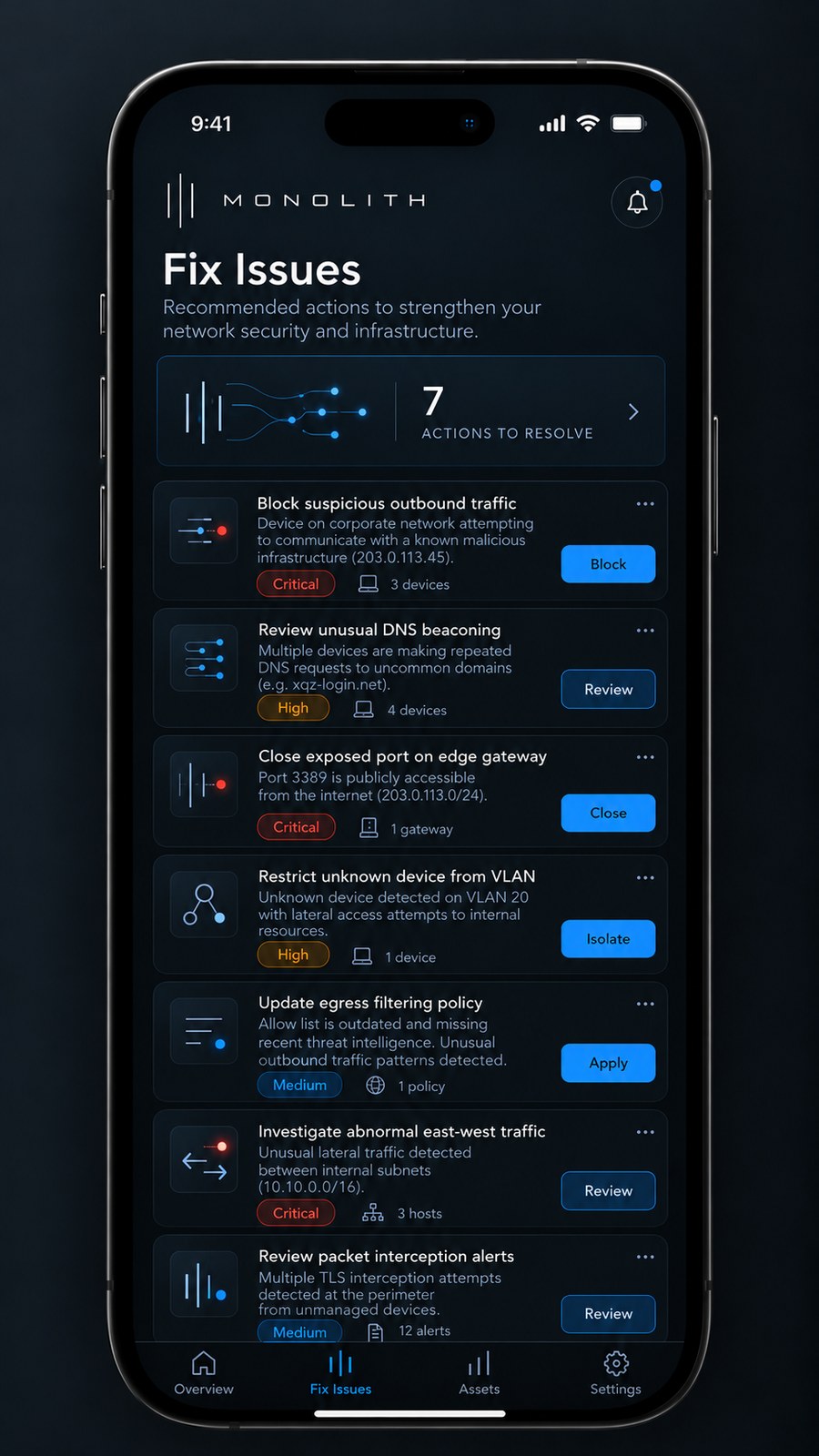
The Monolith app showing a Fix Issues list: block suspicious outbound traffic, review unusual DNS beaconing, close an exposed port, isolate an unknown device, each with a one-tap action button
Fix Issues Everything that needs a decision, ranked by severity, each with the action ready to approve.
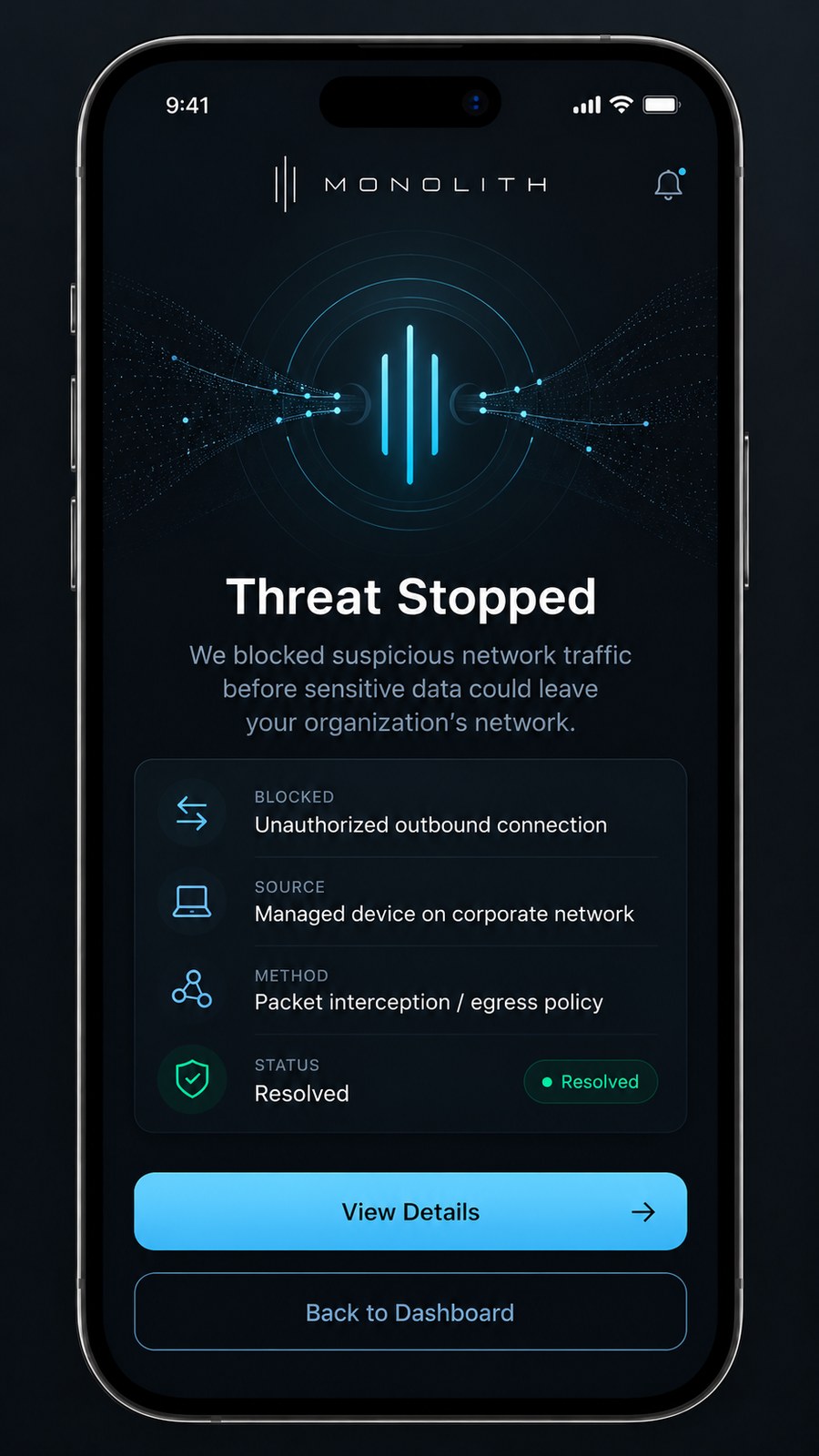
The Monolith app showing a Threat Stopped screen: unauthorized outbound connection blocked from a managed device, method packet interception and egress policy, status resolved
Threat Stopped What was blocked, where it came from, how it was caught, and whether it is resolved.

Deployment

On-premises or in your cloud.
The boundary is yours either way.

Run Monolith as a purpose-built appliance on the intranet, or deploy it into your own cloud tenancy against the same estate. In both cases the telemetry, the findings and the model itself stay inside a boundary you control — nothing is routed through a vendor’s infrastructure.

  • Data residency by construction. Logs, flows, findings and model context stay inside your boundary.
  • You own the weights and the deployment. There is no vendor-side copy of your environment.
  • No upstream dependency. On the appliance, loss of internet connectivity does not degrade detection or response.
  • Egress is a deliberate decision. Any outbound connection is enabled explicitly, per data class, and logged.
  • Bring your own model. If your organisation has already standardised on a model, Monolith is the operator around it. The Monolith Model is the default for teams that have not; it is not a requirement.
The Monolith appliance installed on a credenza in a smaller office
One agent per intranet. Branch, clinic, studio, unstaffed site — or your cloud VPC.

Bring your own model

Already standardised on an internal model?
Monolith is the operator around it.

Many CISOs have spent a year getting a model approved and are not going to unwind that for a security product. They should not have to. Monolith is the operator layer — the chokepoint, the authorisation boundary, the digital twin, the evidence ledger and the network-level isolation — and the model inside it is a component you choose.

  • Your model, served inside your boundary. Point Monolith at the inference endpoint you already run. Nothing about your environment is sent anywhere else.
  • Identical governance. The same per-action authority, approval gates, pre-approved classes and tamper-evident record apply whichever model is doing the reasoning.
  • Swap without re-platforming. Change the model and the operator, the twin, the integrations and the evidence chain stay exactly where they are.
  • Or take ours, at the top of the range. If you would rather not run your own, the Monolith Model is available in its most premium, highest-benchmark build — full-precision BF16 — purpose-built for defenders, doing the work general assistants refuse. Default for teams without an internal model; the upgrade path for teams that want the strongest operator available.
What stays yours · what Monolith supplies
Model and weightsyours, or the Monolith Model (BF16 flagship)
Inference boundaryyours
Telemetry, findings, evidenceyours
Chokepoint operator: detect, fix, isolateMonolith
Authorisation boundary and approval gatesMonolith
Digital twin and intelligence loopMonolith
Network-level isolationMonolith
Command view and evidence ledgerMonolith

Not sure your model is a fit? Ask for the BYO model briefing — we evaluate it against the twin before anything touches production. Book the briefing →


Bounded autonomy

Autonomy you can set, audit, and revoke.

Speed without control is a different kind of risk, and acting is only defensible if someone can stand behind every action. Monolith’s authority is set by you, enforced outside the model, and revocable in one action. It operates to a published controlled-autonomy standard, and every action lands in an evidence chain nobody on your team can edit — which is what you hand the auditor, the regulator or the board when they ask. Three operating modes; the safeguards below hold at every one of them.

SETTING 1

Observe

Detects and reports. Takes no action on the environment.

SETTING 2

Propose and approve

Stages every remediation and executes only on explicit approval.

SETTING 3

Pre-approved autonomy

Executes remediation classes you have authorised in advance. Everything else still waits.

Single revocation controlPauses all missions, freezes workspaces and revokes credentials in one action.
Tamper-evident auditEvery command, output and approval is hash-chained in a store the agent cannot write to.
Scoped by policy, not by promptAuthorisation is enforced at the execution boundary. Destructive and irreversible actions are human-only.

The partnership

Guardian builds the operator.
Blackfrost builds the brain.

Monolith is engineered with Blackfrost AI, who specialise in the one layer we chose not to approximate: cybersecurity models built for defenders, fine-tuned and released with documented precision, footprint, upstream licence and explicit exclusions.

  • They own the model layer. Security-tuned open-weight models, commissioned and de-risked for defensive and agentic workflows.
  • We own the operator. The agent harness, policy engine, evidence ledger, host OS and hardware that turn a model into something you can safely give access to.
  • Neither works alone. A model without governed action is a chatbot. A harness without a security-competent model is a script runner. Monolith is both.
Partner
Blackfrost AI
blackfrost.si · Blackfrost Softwares Corp.

“The model layer for defensive AI. Not another dashboard.”

  • Custom cybersecurity model engineering, with named acceptance criteria
  • Exact model-weight releases under documented licences
  • Incident analysis, malware analysis, detection engineering, secure-code review
  • Built for defense. Scoped for control.
Without the box

The Monolith Model, on its own.

Not every site wants an appliance, and not every team needs our model. If you already run a SOC, a cloud estate or your own GPUs, you can license the security model on its own and point it at what you already have — cloud workloads included. If you already have a model, skip this and bring it.

Cloud protection

Run the model against cloud and SaaS telemetry: identity, endpoint and network evidence correlated into an incident timeline, without an on-site box.

Your own hardware

License the weights and run them on infrastructure you already own. Documented precision, footprint, upstream licence and explicit exclusions.

Private hosting

Separately scoped capacity, runtime, APIs and infrastructure controls if you want the model served without operating it yourself.

Monolith Model — builds

Monolith Model builds, with precision, footprint and licence price
BuildPrecisionFootprintBest fit
Monolith Model Master — flagship, highest benchmarkBF16~4.5 TBDatacentre and private-cloud deployment; the reference build and the strongest operator we ship
Monolith Model FP8FP8~2.4 TBMulti-GPU servers where BF16 will not fit
Monolith Model NVFP4NVFP4~1.4 TBThe smallest footprint that keeps the flagship architecture

The Monolith Model is a 2.4-trillion-parameter de-risked release engineered with Blackfrost AI and packaged under the Monolith name. None of these builds fits on a single on-premises box — that is exactly why the appliance runs smaller quantised models locally and the Monolith Model is offered for cloud and datacentre deployment.


The hardware

The Monolith device.
Purpose-built, in-line, attested.

Monolith is an appliance, not software you install on a desktop. It is built around one job — sitting at the chokepoint of an intranet and running a security operator there, continuously, with inference inside the box — and every part of it, from the host OS to the fin stack, is there to do that job. Figures are at 32k context, two concurrent agents, and 24 GB held back for the OS and workspaces.

Monolith device specifications
SpecificationMonolith device
RoleIn-line intranet security operator: detect, fix, isolate at the network layer, with the command view and evidence ledger on the device
PlacementBetween the edge and everything behind it. Wired network and power; nothing to install on endpoints
Memory192 GB unified, sized for the Monolith Model on-device with two concurrent agents at 32k context
InferenceLocal. The model runs inside the box; no upstream dependency, no vendor round trip. Loss of internet does not degrade detection or response
Power30 W idle · 220 W under load. Passive fin stack, low acoustic footprint; office, closet or rack
Trusted computeSecure boot, signed host OS, measured boot and attested runtime. The device proves what it is running before it is allowed to act, and demands the same of what connects
RuntimeAgent-native OS with contained full-system access: disposable snapshot-able workspaces, short-lived capability tokens, egress allow-lists
IsolationNetwork-level: host, identity, agent or segment cut at the wire in seconds, reversible in one action
EvidenceHash-chained store on the device that the agent cannot edit; exportable for audit
ModelMonolith Model (BF16 flagship or FP8 / NVFP4 builds), or your own model served inside the boundary
SupportHardware support, signed updates, and the operating loop maintained by Guardian with Blackfrost AI

Four layers, one device

Models tuned for security work · harness as the 24/7 agent runtime · agent-native OS with contained full-system access · hardware built to hold all three. Each layer is built to fit the one above it.

Contained by design

Disposable snapshot-able workspaces, short-lived capability tokens rather than standing credentials, network egress allow-lists, and an evidence store the agent cannot edit.

Off-grid go-box

A portable variant: the same operator with a full-day battery, standalone satellite uplink and solar input in one case, so it can be stood up anywhere.

Detail of the Monolith power and ethernet connections
Power and wired network. It sits between your router and everything else.
The Monolith appliance in the corner of an office
Office deployment. Branch, clinic, studio, unstaffed site.

Already have the hardware? Monolith can also run on GPU workstations or high-memory machines you own. Tell us what you have and we will check the fit. Bring your own hardware →

Go deeper

How each part of Monolith works.

Continuous control validation

Why an annual pentest is one data point, and how Monolith supplies the other 364.

Read →

True-positive attack paths

Chaining identity, endpoint and network evidence into a verdict in seconds.

Read →

Intelligence to detection

TTPs and IOCs run against a digital twin; silence becomes a deployed detection.

Read →

How the simulations actually run

The digital-twin loop, step by step, for CISOs and CTOs — including where it is guessing.

Read →

Autonomous vulnerability management

Discover, assess reachability, fix and verify as one loop.

Read →

Insider threat in the AI environment

Human and machine identity as one problem, enforced outside the model.

Read →

Network access control for AI

Per-action, per-agent authorisation that fails closed.

Read →

On-premises or your cloud

Two deployment models, one boundary you own.

Read →

Why general AI refuses security work

And why a model built for defenders does the job.

Read →

Fraud at superintelligence scale

Scale and sophistication shifted at once. Fraud is now a top-tier threat.

Read →

Hyper-humanised agents and deepfake calls

Voice and video the average person cannot tell from a human.

Read →

Spoofing and phishing, rebuilt

$3.04B in BEC losses in 2025. Defending the layer the campaign depends on.

Read →

Investment and romance fraud

Investment clubs, scam centres and the backstop that passes every check.

Read →

Stopping social engineering at the hardware layer

Every attack ends in an action. The chokepoint holds, verifies, blocks or isolates it.

Read →

See it exercise your controls.

Tell us about the estate and the model you run, if you have one. In week one we run the twin against a slice of it and show you a real gap with the fix staged. Then we scope on-premises or cloud deployment and get you a quote.

Number of sites, rough asset count, what you run today, on-prem or cloud, and your timing. Please do not include credentials or sensitive company data.

We reply within one business day. Or email info@guardianrobotics.com.

Message received

Thank you. A member of the Guardian team will be in touch within one business day.